What is API Management? A Comprehensive Guide
In this tutorial, we will learn the fundamental concepts and functionalities of API Management. Then, we will shed light on the distinctions between API Management, API Gateway, Load Balancing, and Reverse Proxy — essential components in modern network architectures..
API Management in a nutshell
API Management refers to the process of designing, deploying, monitoring, and securing Application Programming Interfaces (APIs) in a way that allows organizations to control, govern, and optimize the interaction between their APIs and the developers, applications, and systems that consume them. API Management encompasses a set of practices, tools, and services that help organizations manage their APIs effectively throughout their entire lifecycle.
The following picture contains an overview of the typical features of an API Management Product:
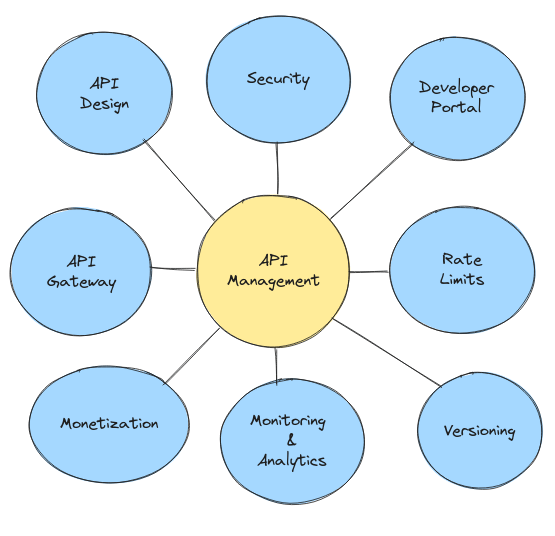
There are several platforms that provide an API Management systems such as Red Hat’s 3scale which offers API management solutions, including traffic control, analytics, and developer onboarding features.
To learn more about 3scale, we recommend the following article: Getting started with API Management
API Gateway vs Reverse Proxy vs Load Balancer
As discussed at the beginning of this article, API Management is a broader term that encompasses the overall process of designing, developing, publishing, and operating APIs. It includes everything from defining API specifications and creating developer portals to monitoring API usage and enforcing security policies.
Besides API Management, there are several other components such as API Gateway, Reverse Proxy, and Load Balancer which also belong to modern network architectures. Yet they serve distinct yet interconnected purposes. Let’s see them more in detail to understand the key differences:
An API Gateway acts as a single entry point for all API requests, providing a centralized location for managing security, authentication, and other cross-cutting concerns. It can also help to simplify API discovery and consumption by providing a standardized interface for accessing multiple APIs.
A Reverse Proxy is a server that sits in front of one or more web servers, intercepting requests from clients and forwarding them to the appropriate server. Reverse Proxies can improve performance by caching frequently accessed content and offloading some of the processing load from the web servers. They can also enhance security by filtering out malicious requests and providing secure connections between clients and servers.
A Load Balancer distributes incoming traffic across multiple servers, ensuring that no single server becomes overloaded. This can improve performance and availability, especially for applications with high traffic volumes. Load Balancers can also help to protect against server failures by automatically rerouting traffic to other servers if a server goes down.
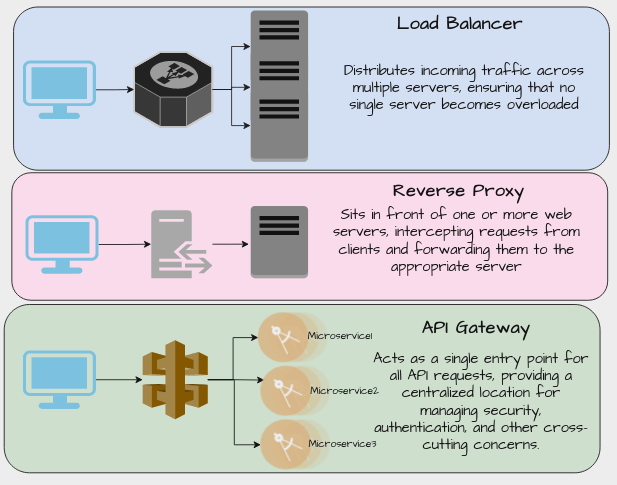
Finally, here is a tabular review of the concepts we have discussed so far:
| Aspect | API Management | API Gateway | Reverse Proxy | Load Balancer |
|---|---|---|---|---|
| Scope and Purpose | Comprehensive API lifecycle management including design, deployment, monitoring, and security | Runtime management of API traffic including routing, security, and traffic control | Handling incoming requests on behalf of backend services | Distributing incoming network traffic across multiple backend servers |
| Primary Functions | API design, development, deployment, security, monitoring, analytics, developer portal, policy enforcement | Request routing, authentication, authorization, rate limiting, caching, error handling, transformation | Handling incoming requests, SSL termination, security, load balancing | Load distribution, scaling, high availability, health checks |
| User Roles | API product managers, developers, administrators, consumers | DevOps, infrastructure teams | DevOps, infrastructure teams | DevOps, infrastructure teams |
| Components | API design tools, developer portal, analytics, policy engine | Routing rules, security policies, caching, load balancers | SSL/TLS termination, security mechanisms | Load balancing algorithms, health check configurations |
| Security | Comprehensive security features, authentication, authorization | Authentication, authorization, security mechanisms | Security mechanisms (e.g., SSL/TLS), request filtering | Security mechanisms (e.g., SSL/TLS), access control |
| Rate Limiting | Supported | Supported | Typically not a primary function | Typically not a primary function |
| Monitoring & Analytics | Comprehensive monitoring, analytics, and reporting | Real-time monitoring, request/response logging, performance metrics | Limited monitoring, traffic logs | Monitoring, traffic statistics, health checks |
| Content Transformation | Supported | Supported | Request/response transformation | Typically not a primary function |
| Versioning | Supported | Typically not a primary function | Typically not a primary function | Typically not a primary function |
| Developer Portal | Included | May or may not be included | Not included | Not included |
| Policy Enforcement | Comprehensive policy management and enforcement | Policy enforcement for API traffic | Limited policy enforcement | Limited policy enforcement |
| Monetization | Supported | Typically not a primary function | Typically not a primary function | Typically not a primary function |
| Ecosystem Building | Fosters an ecosystem around APIs | Facilitates API consumption | Typically not a primary function | Typically not a primary function |
| High Availability | Supported | High availability often a requirement | May support high availability | Typically supports high availability |
| Disaster Recovery | Supported | Disaster recovery often a requirement | May support disaster recovery | May support disaster recovery |
Conclusion
In conclusion, we’ve embarked on a journey through the intricate landscape of API Management, discussing its significance in modern digital ecosystems. From the initiation of APIs as the lifelines of application communication to the nuanced roles played by API Management platforms, we’ve explored how businesses can optimize their connectivity and collaboration.
Furthermore, we’ve demystified the distinctions between API Management, API Gateway, Load Balancing, and Reverse Proxy, recognizing their unique contributions to network architectures. As organizations continue to navigate the complexities of digital integration, mastering these components becomes imperative for fostering resilience, security, and scalability.